KVLCC2
The KRISO Very Large Crude Carrier (KVLCC2) was conceived by the Korea Research Institute of Ships and Ocean Engineering (KRISO) to provide high-quality data for both the investigation of flow physics and the validation of computational fluid dynamics (CFD) methods.
It represents a tanker ship (ca. 1997) with a full hull form and a bulbous bow and it is widely used as a benchmark model in ship hydrodynamics for both experimental and numerical studies.
The KVLCC2 geometric data are publicly available here.
The imported geometry of the original KVLCC2 is included in the sample file under the scope import_KVLCC2.
Parametric Model Overview
This sample demonstrates how a fully parametric version of the KRISO Very Large Crude Carrier (KVLCC2), including the propeller and rudder, can be modeled using the Ship Modeling Workflow (SMW).
Load Model
The primary goal of this sample is to provide a parametric KVLCC2 hull that can be easily modified and extended.
The model is designed to be both robust and flexible.
Although the baseline design does not exactly match the original geometry, the deviation is minor and acceptable for demonstration and validation purposes.
This model was created by modifying only the provided design variables in the SMW models.
An even closer geometric match could be achieved with additional effort; however, the objective here is to demonstrate how quickly a high-quality fit can be obtained.
Comparison Between Original and Parametric Geometry
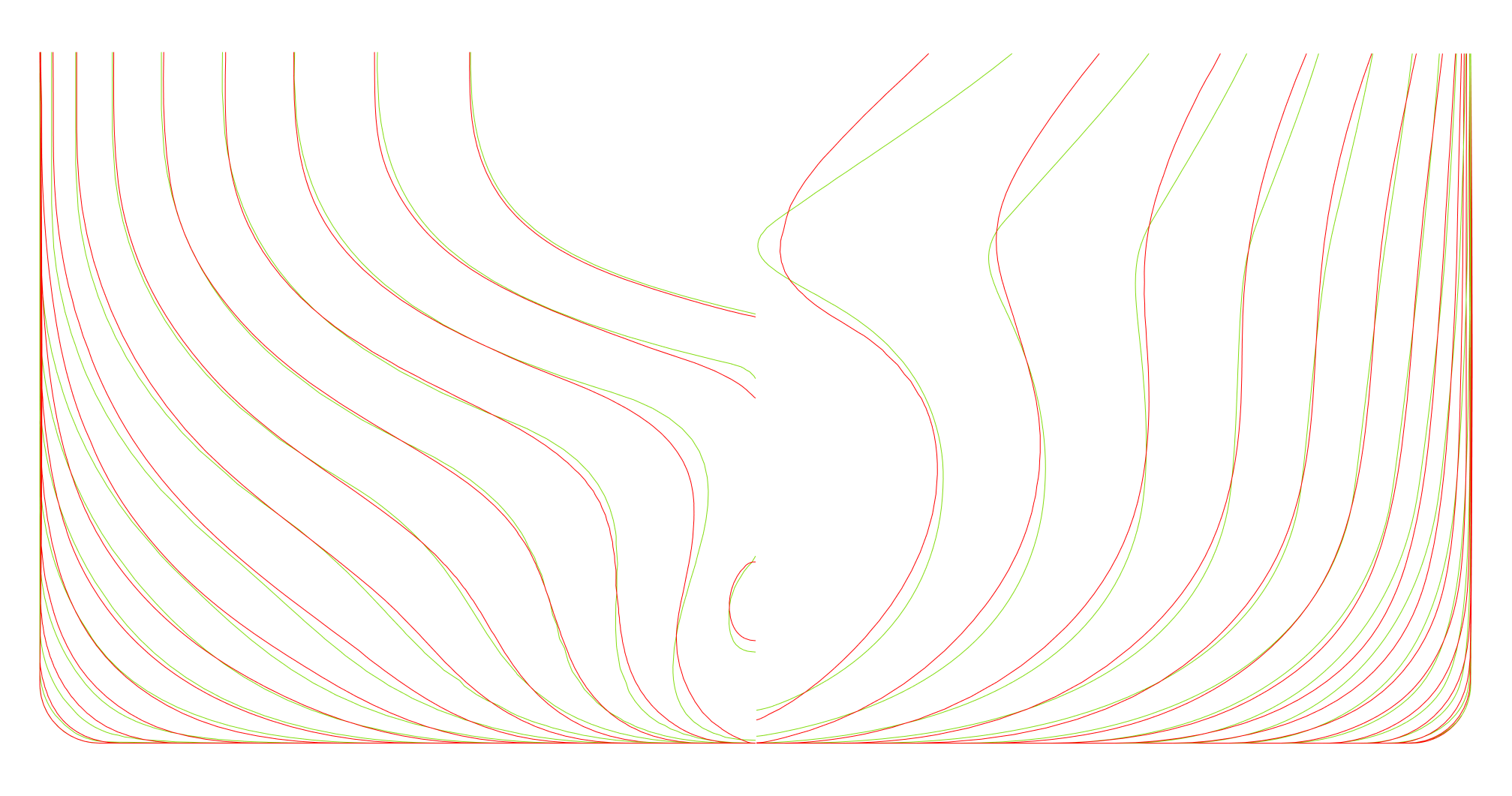
A comparison between the station curves of the original geometry (shown in red) and the parametric rebuild using the ship modeling workflow (SMW) geometry (shown in green) is illustrated below.
A practical strategy to match the original hull as closely as possible is to proceed from big to small adjustments. First, set identical main dimensions, then adjust relative dimensions and finally refine the sectional shapes to capture the characteristic geometry patterns.
Aft and Fore Region
Hydrostatics
A comparison of the hydrostatics between the original geometry and the parametric ship modeling workflow (SMW) model is also performed.
| Name | Unit | Original | SMW |
|---|---|---|---|
| LPP | m | 320.00 | 319.62 |
| Displacement | m³ | 312622 | 312993 |
| Wetted surface (w/o rudder) | m² | 27194 | 27759 |
| Block coefficient (CB) | – | 0.8098 | 0.8120 |
| Midship coefficient (CM) | – | 0.9980 | 0.9980 |
| LCB (forward +) | % | 3.4800 | 3.5454 |
Propeller Geometry
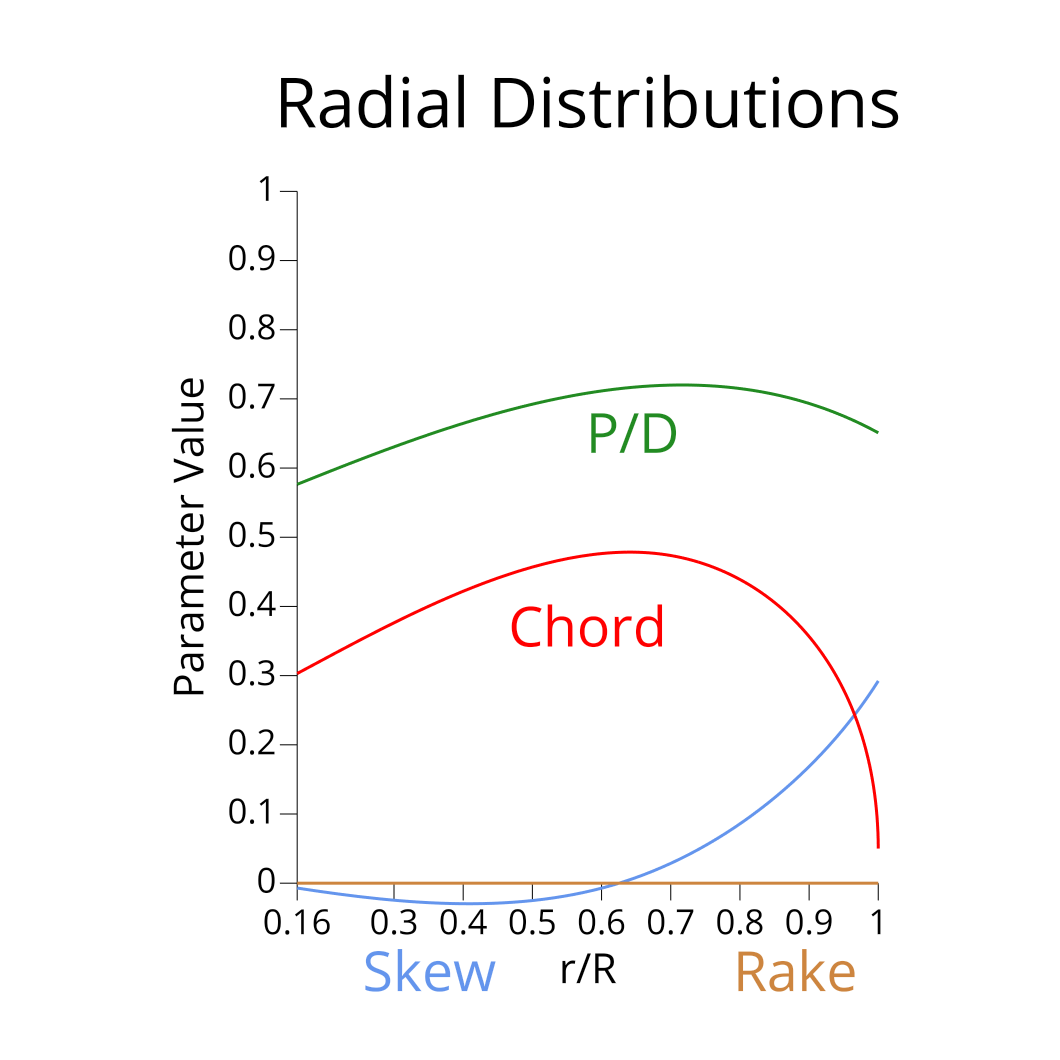
The propeller geometry for the KVLCC2, corresponding to the 4-bladed KP458 propeller, is designed in CAESES using the Advanced Propeller Workflow and is imported into this project as a STEP file.
The resulting radial distributions are shown below.
Conditions for Computations
In addition to the geometric model, the Ship Object can also inherit data required for numerical computations.
In this model, the original test conditions are applied:
- Design draft:
20.8m - Service speed:
15.5knots
You need to create new Operating Conditions in the Ship Object and specify the Service Speed there.