Basic Ship Hull
This sample illustrates how a simple fully-parametric ship hull can be modeled with the use of longitudinal curves and meta surfaces.
Load Model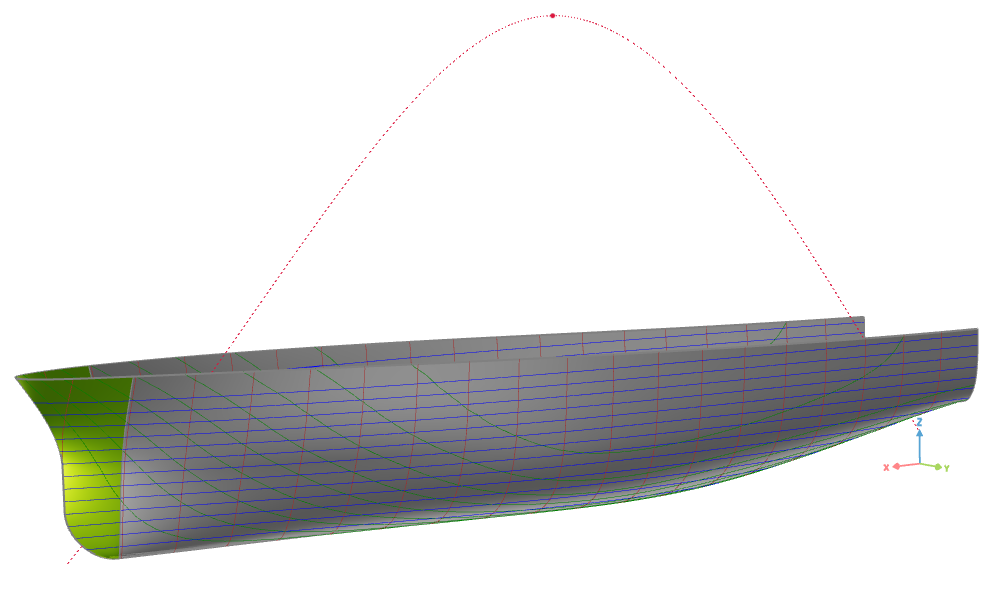
The section topology of the hull is defined in a feature definition. The feature definition is connected to continuous distributions of the section input parameters, the longitudinal curves, by the curve engine object. The curve engine is then used by the meta surface entity to generate a surface which is completely mathematically defined, hence no lofting is used. Global parameters are located in the scope |parametricModel|parameter, while local parameters can be found in the scope of the basic curve they belong to (|parametricModel|basicCurves|...).
The longitudinal basic curves are created with a feature (CAD > Curves > Point based > Multi-Segmented). This feature creates a multi-segmented planar curve to be conveniently used as basic curve for a parametric model. The required input comprises the plane and elevation, number of intermediate points, abscissa and ordinate values for every point. Tangents at every point and fullness values for the single curve segments can be set at discretion.
The modeling of the sectional area curve (SAC) is done using a partially parametric technique to obtain specified CP and XCB values. First an initial SAC is generated with the mentioned feature and local curve parameters like positions and tangents. This curve's CP and XCB are analyzed and compared with the desired values. Then, using the difference between the values, the SAC is transformed with a Lackenby transformation to conform to the desired values.