Design Space Exploration
The design space exploration (also called design of experiments (DOE) or sampling) is a good starting point to scan the design space created with the free design variables.
CAESES provides a set of sampling methods that allow you to create, explore and analyze new design candidates in an automated way.
You find all design engines in Optimize > Optimization > Design Space Exploration
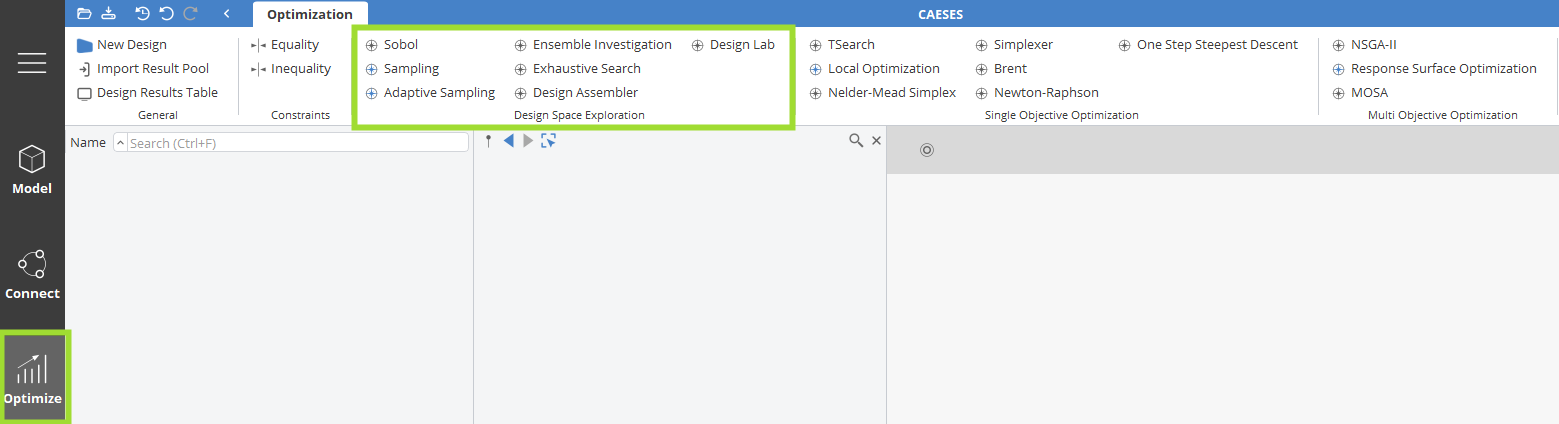
Sobol
The Sobol design engine is a quasi-random sequence generator. The design variable values are sampled randomly but more evenly when comparing the distribution to pseudo-random number generators.
This engine is suited for design explorations (or design of experiments, DoE). The generated designs can also be computed in parallel. The result of such a run can also serve as input for response surfaces.
Sampling - Latin Hypercube (Dakota)
Advanced OptThis functionality requires the Advanced Opt add-on to be enabled.As an alternative to the Sobol design engine, this sampling strategy is also recommended for design explorations and can be combined with response surface optimization. The sampling method behind it is the popular Latin Hypercube Sampling (LHS). This strategy is robust and can be applied to any problem. Designs can also be evaluated in parallel, or distributed on HPC clusters etc.
It is called "Sampling" in CAESES can be found in the optimization tab in the Design Space Exploration category and requires the advanced optimization add-on.
Adaptive Sampling (Dakota)
Advanced OptThis functionality requires the Advanced Opt add-on to be enabled.In addition to Latin Hypercube sampling there is an intelligent adaptive sampling method, which is included in the Dakota design engine. The goal of performing adaptive sampling is to construct a surrogate model that can be used as an accurate predictor for a computationally expensive simulation. Thus, it is advantageous to build a surrogate that minimizes the error over the entire domain of interest using as little simulation runs as possible.
The adaptive part refers to the fact that the surrogate will be refined by focusing simulation samples in particular areas of interest, rather than entirely relying on random selection or standard space-filling techniques. The method uses a Gaussian process (Kriging) model as a surrogate, based on an initial set of simulation results from a Latin Hypercube sampling, which is iteratively augmented by additional data points in regions of the design space where the error of the surrogate is predicted to be the highest.
Ensemble Investigation
You can specify an individual series of values that should be used for each design variable. Here are examples for series:
1,3,6,1042,39,23.5,170,2..200,2..20,20.5,21..300,20:110,20:11,30:2130,0:7
See the series documentation for more information.
Exhaustive Search
This engine subdivides the feasible domain of each variable into a fixed number of subintervals, where for example, one subdivision results in two evaluation runs. This algorithm is also known as brute-force method or direct search.
Design Assembler
This engine allows you to consider and import an ASCII file (csv) that contains the design variable values for a set of designs. The data should be provided in a simple format where each row represents a design, separated by commas. The values then need to be connected to existing design variables in your current project.
Design Lab
This design engine allows you to conveniently create new design manually by using a set of sliders.
As an alternative to this engine, you can simply create a manual design through the optimization menu ("Create new design from current design"). The benefit of the design lab is that you can create new variants manually while other designs are still running.