Computational Methods
Boundary Element Method (BEM)
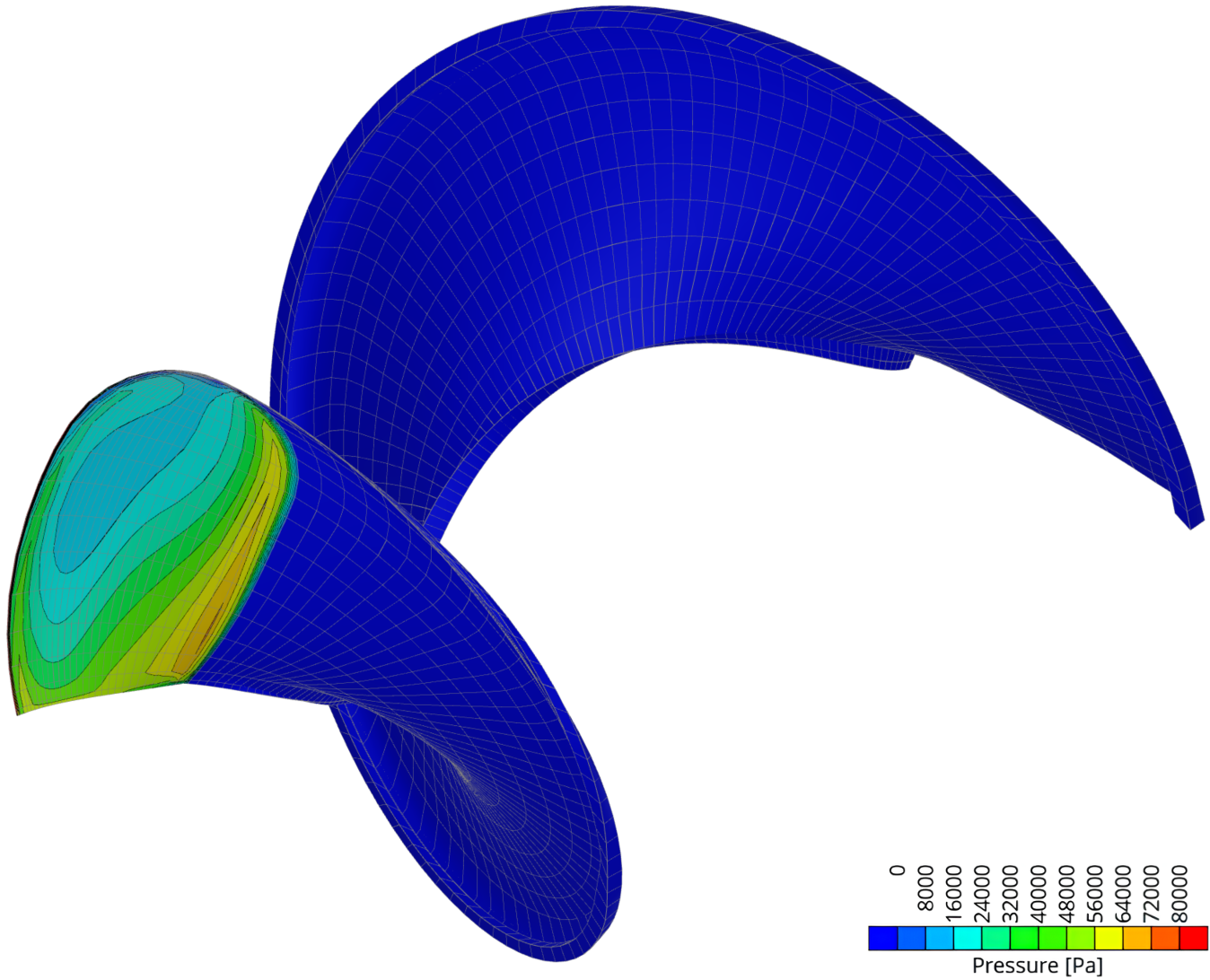
Potential flow theory simplifies the fluid flow around solid objects like marine propellers by neglecting viscosity, allowing the fluid dynamics problem to be expressed through a velocity potential and significantly reducing computational costs [13]. In a Boundary Element Method (BEM) framework, a panel mesh represents the body, while the wake geometry illustrates the pressure distribution on the blade. The correct wake geometry, shown in blue, satisfies the Kutta condition at the TE and in the propeller's wake. This method offers advantages over other computational techniques, such as RANS simulations, which require generating a mesh for the entire computational domain, a time-consuming task. The pressure distribution derived from potential flow theory determines both the thrust and torque generated by the propeller.
Reynolds-averaged Navier–Stokes (RANS)
Reynolds-Averaged Navier-Stokes (RANS) simulations provide a detailed approach to modeling fluid flow around objects such as marine propellers [14]. Unlike potential flow theory, RANS simulations account for viscosity effects, making them suitable for capturing turbulence and boundary layer phenomena. In these simulations, the Navier-Stokes equations are averaged over time to yield steady-state or time-averaged flow fields, offering insights into complex flow behaviors such as separation, vortex shedding and turbulent mixing. RANS simulations deliver a more accurate representation of real-world flow dynamics, which is essential for predicting propeller performance, assessing cavitation risk and optimizing design parameters in various marine applications.
Domain
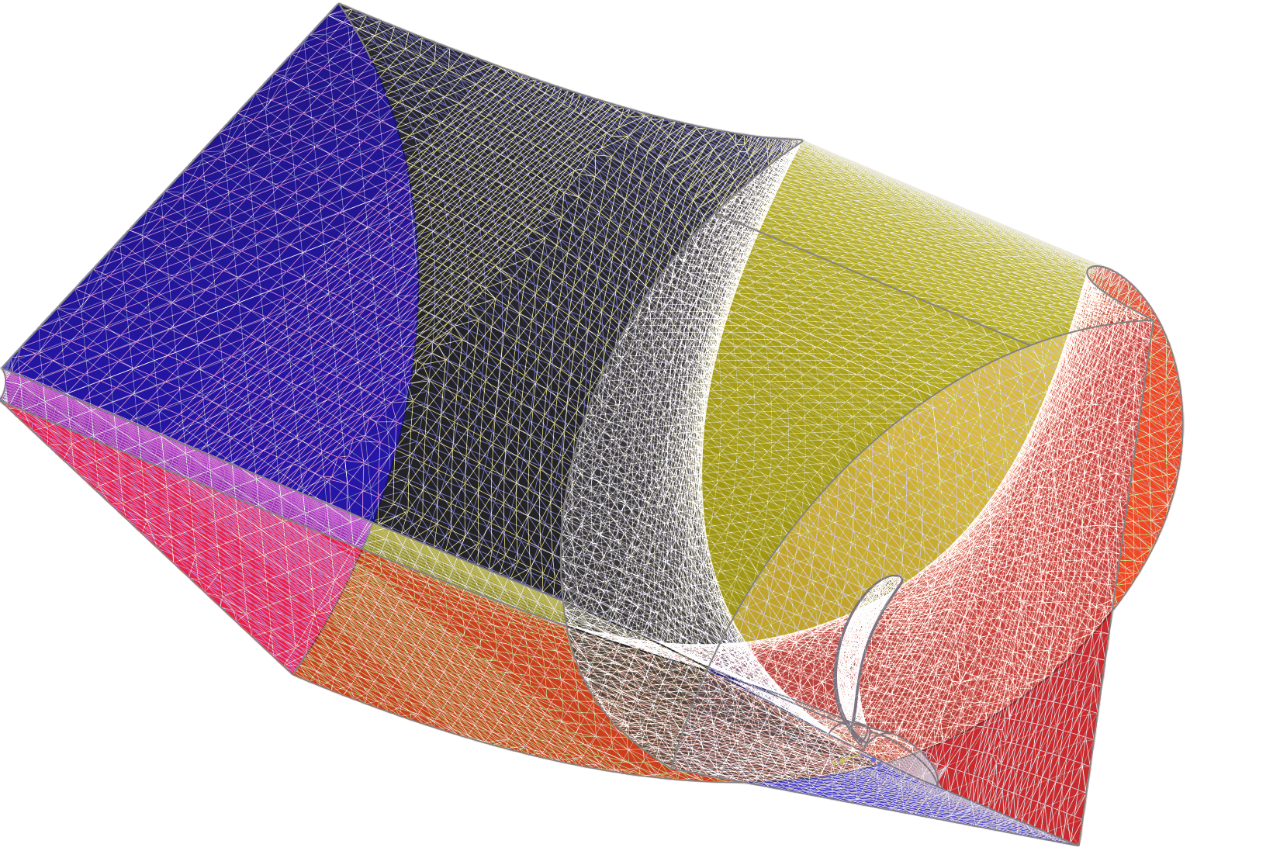
The computational domain in RANS simulations is including the entire flow field. For steady-state problems, a single blade can be used due to symmetry assumptions, which can save computational time and provide reasonable results with an axial domain instead of a full cylindrical domain.
Mesh
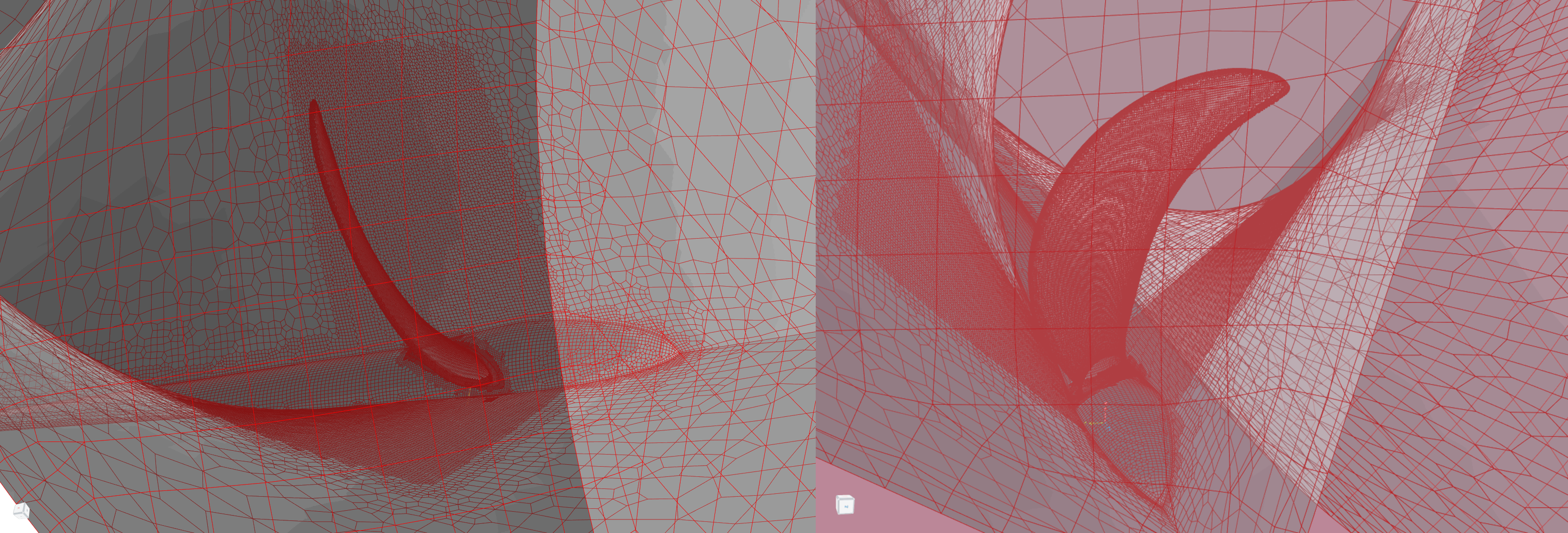
The figures below show examples of meshes used for computational simulations. The mesh is generated based on the axial domain input and it is where the Navier-Stokes equations are solved. Mesh generation can be a complex and time-consuming task, but nowadays, many software tools automate this process.
Comparison
- Boundary Element Method (BEM)
- Lower Computational Costs: BEM simplifies the fluid dynamics problem by neglecting viscosity and using a panel mesh for the propeller, which significantly reduces the time and computational resources needed for simulations.
- Less Accurate for Complex Flows: BEM does not account for viscous effects, making it less reliable for capturing complex flow phenomena such as turbulence, separation and cavitation, especially at high angles of attack.
- Reynolds-Averaged Navier-Stokes (RANS)
- Comprehensive and Accurate Analysis: RANS includes viscosity effects and captures detailed flow behaviors like turbulence, separation and cavitation, providing a realistic and accurate representation of propeller performance.
- Higher Computational Costs: RANS requires a detailed volumetric mesh of the entire flow domain and involves more complex setup and longer simulation times, demanding greater computational resources.
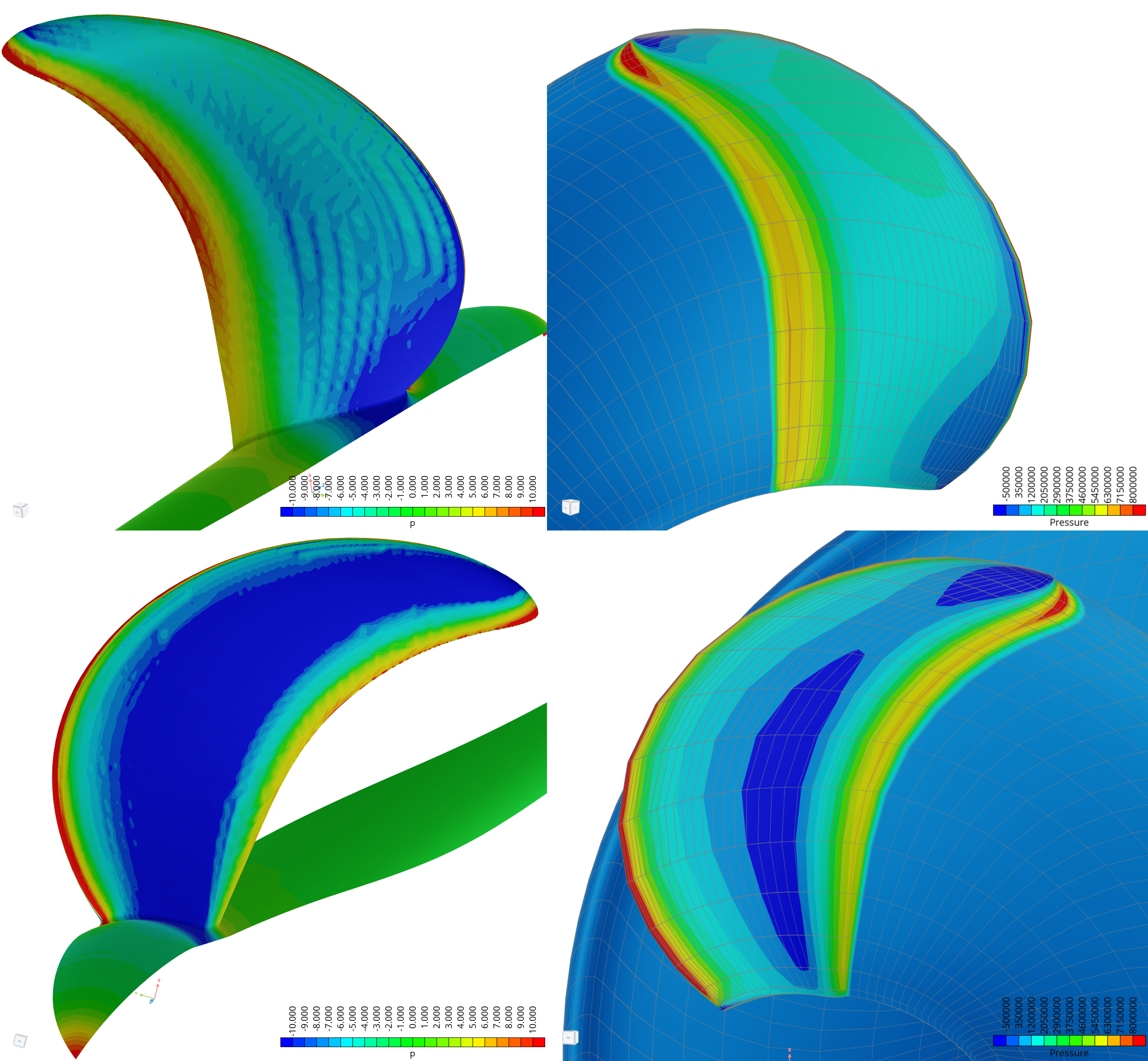
The figure below illustrates the pressure distribution on a marine propeller using two different computational methods:
- Reynolds-Averaged Navier-Stokes (RANS) on the left and
- Boundary Element Method (BEM) on the right.
With proper conditions and fine-tuning, both methods can provide reasonable and closely matched results. Despite differences in computational complexity and inclusion of viscosity effects, the overall pressure distributions are quite similar, demonstrating the effectiveness of both methods in predicting propeller performance.