Structural Design
Propeller Thickness
Propeller thickness is a critical aspect of propeller design, determining the structural integrity and durability of the propeller under various operating conditions. The thickness must be sufficient to withstand the stresses induced by hydrodynamic forces and cavitation. Proper thickness distribution also affects the overall efficiency and performance of the propeller [11].
Hydrodynamic Efficiency
Thinner propeller blades are generally more efficient because they reduce the drag and resistance encountered as they move through water. This is due to the fact that a thinner blade has a smaller cross-sectional area, which decreases the frictional drag and the formation of vortices. This efficiency is not limited to CFD simulations but is also observed in practical applications. A thinner blade allows for smoother flow around the blade surface, minimizing wake turbulence and energy loss. However, thickness must still be considered as a constraint to prevent issues such as blade cracking and to minimize stress concentrations. Traditionally, thickness distribution followed a linear function, decreasing from maximum at the hub to minimum at the tip. Modern designs now often use concave, upward-decreasing thickness functions to optimize performance while adhering to established rules and regulations.
Rules and Regulations
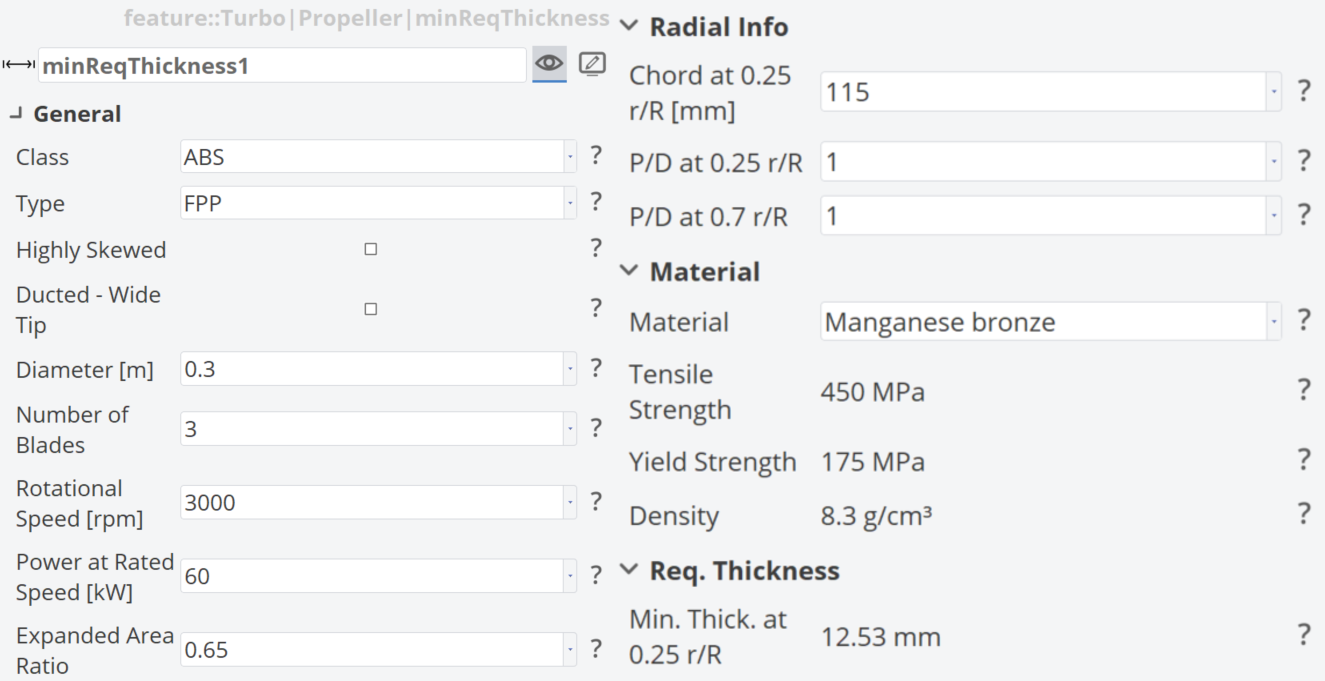
Inside CAESES, a feature named minReqThickness calculates the minimum required thickness for marine propellers, ensuring compliance with regulations from various class societies such as ABS, BV and RINA. Input parameters include propeller type (fixed-pitch or controllable-pitch propellers), diameter, rotational speed, power at rated speed, expanded area ratio, number of blades, radial information (chord, pitch, skew and rake) and propeller material. Additionally, unconventional geometries like highly skewed or wide tip propellers (ducted) can be accommodated. Outputs provide minimum thickness at various radial locations and properties of the selected material.
Propeller Fillet
The propeller fillet is an important design feature in marine propellers, located at the junction where the blade meets the hub. It plays a crucial role in enhancing the structural integrity and hydrodynamic performance of the propeller. Properly designed fillets reduce stress concentrations and improve the flow of water around the blades, leading to better efficiency and durability. A well-designed fillet smooths the transition between the blade and hub, minimizing turbulence and drag, which enhances the propeller's overall efficiency. By reinforcing the connection between the blade and hub, the fillet contributes to the structural integrity of the propeller, allowing it to withstand high loads and operational stresses.
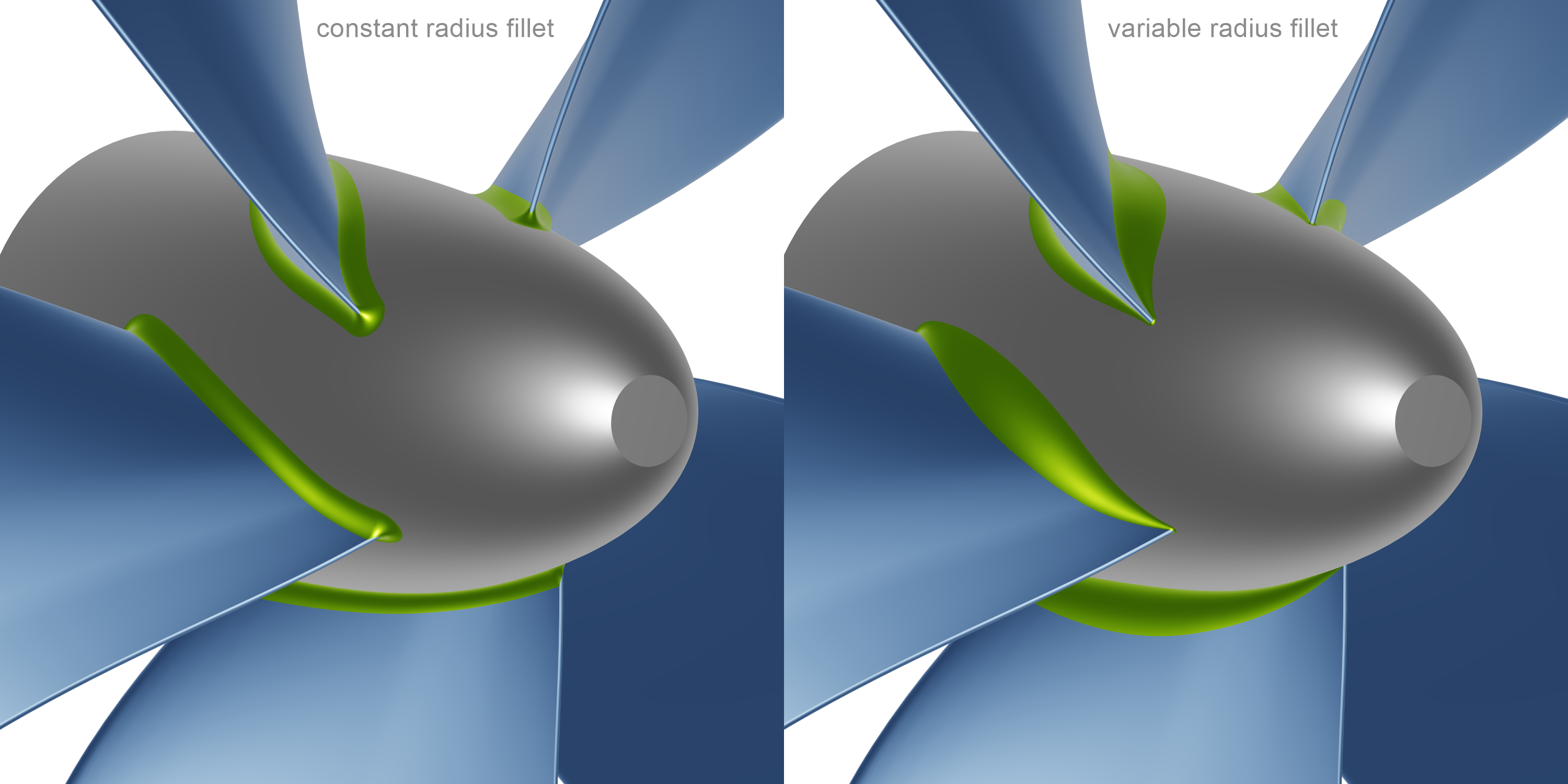
In CAESES, you can work with two types of fillet radii: constant and variable. A constant fillet radius features a uniform curvature from the blade to the hub, while a variable fillet radius involves a curvature that changes along the transition between the blade and the hub.
Constant Radius Fillet
- Uniform Stress Distribution: Consistently transitions stress at the blade-hub junction.
- Ease of Manufacture: Features a simple design and manufacturing process.
- Predictable Performance: Ensures consistent hydrodynamic and structural performance.
Variable Radius Fillet
- Optimized Stress Distribution: Tailors stress distribution to reduce peak stresses and enhance durability.
- Improved Hydrodynamics: Reduces turbulence and drag for better efficiency.
- Customization: Allows for tailored design to meet specific performance and operational needs.
- Rule of Thumb: Typically, it is 2/3 of the thickness distribution of the profile at the root for the pressure side and 1/3 for the suction side.
Shaft Axis
The shaft axis, often referred to simply as the propeller shaft, is the component that connects the engine to the propeller hub. It transmits the rotational power from the engine to the propeller, enabling the conversion of engine power into thrust. Key aspects of the shaft axis include:
- Alignment: Proper alignment of the shaft axis is crucial for efficient power transmission. Misalignment can cause vibrations, increased wear and potential damage to the propulsion system.
- Support: The shaft is supported by bearings and struts along its length to ensure smooth rotation and minimize friction. The design of these supports must account for the forces and torques experienced during operation.
- Sealing: The shaft passes through the hull of the vessel, requiring effective sealing to prevent water ingress. This is typically achieved with the use of shaft seals, which must be maintained to ensure watertight integrity.
Materials
Marine propellers are critical components in the propulsion systems of ships and submarines. The choice of material for a marine propeller is crucial as it affects the propeller's performance, durability and resistance to corrosion [12]. Here are some common materials used for marine propellers:
Bronze Alloys
Bronze alloys are the most commonly used materials for marine propellers. They are favored for their excellent corrosion resistance, strength and durability. The most prevalent types of bronze used in propeller manufacturing include:
- Manganese Bronze: Known for its high strength and toughness, manganese bronze is often used in high-performance propellers.
- Nickel-Aluminum Bronze: This alloy offers superior resistance to corrosion and biofouling, making it ideal for use in seawater.
Stainless Steel
Stainless steel propellers are highly durable and resistant to corrosion and wear. They are particularly suitable for high-speed vessels and boats that operate in harsh environments. The primary advantages of stainless steel propellers include:
- High Strength: Stainless steel provides excellent resistance to impact and deformation.
- Corrosion Resistance: This material is highly resistant to rust and corrosion, especially in saltwater conditions.
Aluminum
Aluminum propellers are popular for small to medium-sized boats due to their lightweight and cost-effectiveness. Although not as durable as bronze or stainless steel, aluminum propellers offer several benefits:
- Lightweight: Easier to handle and install, reducing the overall weight of the vessel.
- Cost-Effective: More affordable compared to bronze and stainless steel, making it a common choice for recreational boats.
Composite Materials
Composite propellers are made from a combination of materials such as carbon fiber and reinforced plastics. These propellers are gaining popularity due to their unique properties:
- Lightweight: Significantly lighter than metal propellers, which can improve fuel efficiency.
- Corrosion Resistance: Highly resistant to corrosion, particularly in saltwater environments.
- Customizability: Can be designed and molded into complex shapes for enhanced performance.