Wageningen B-Series
Geometric Characteristics
The Wageningen B-series propellers are well-known as one of the most extensive and frequently employed series of conventional fixed-pitch propellers in the maritime industry [10]. The B-series can be understood as a parametric model, represented by the notation BZ-y. Here, signifies the B-series, corresponds to the number of blades ranging from to and represents the expanded area ratio ( ) spanning from to . Another crucial parameter is the face pitch-diameter ratio ( ), where denotes diameter, and ( ) varies between and . These primary parameters, complemented by secondary attributes such as rake angle and thickness at the leading and the trailing edge, collectively provide a comprehensive definition of the propeller blade.
B-series Polynomials
The B-series propellers were tested in uniform flow with a specified Reynolds number of (). The results from these tests were subjected to multiple regression analyses. Polynomial equations were derived to represent the thrust and torque coefficients as functions of , , and . For Reynolds numbers exceeding (), adjustments of the aforementioned coefficients should be made using correction terms and . Additionally, tables for () are required to provide the specific coefficients used in these equations.
CAESES based Web Application
A web service that generates a solid propeller geometry of the Wageningen B-Series. The web application is powered by CAESES and can be found on our Wageningen B-series website. The great thing about this tool is that no extra installations are needed; you can use it directly in your browser.
The online apps allow you to quickly generate high-quality CAD geometry for the B-series propeller. It’s absolutely simple to use and beautifully designed to make propeller design a joy.
You have two choices: A preliminary design tool and a direct geometry generator for advanced controls.
Design Tool
The first propeller app is a preliminary design tool.The shape generation is based on the following typical preliminary design inputs:
- Diameter
- Area ratio
- Number of blades
- Vessel speed
- Engine power
- Engine RPM
- Gear ratio
- Propeller material
- Wake number
- Water density
✏️ Enter your information about the ship and the propulsion system.
🧮 We do the calculation to find a suitable propeller shape that fits your requirements – in just a few seconds.
🔍Check the visualization of the propeller.
💾 Download the final STEP/STL file of the propeller.
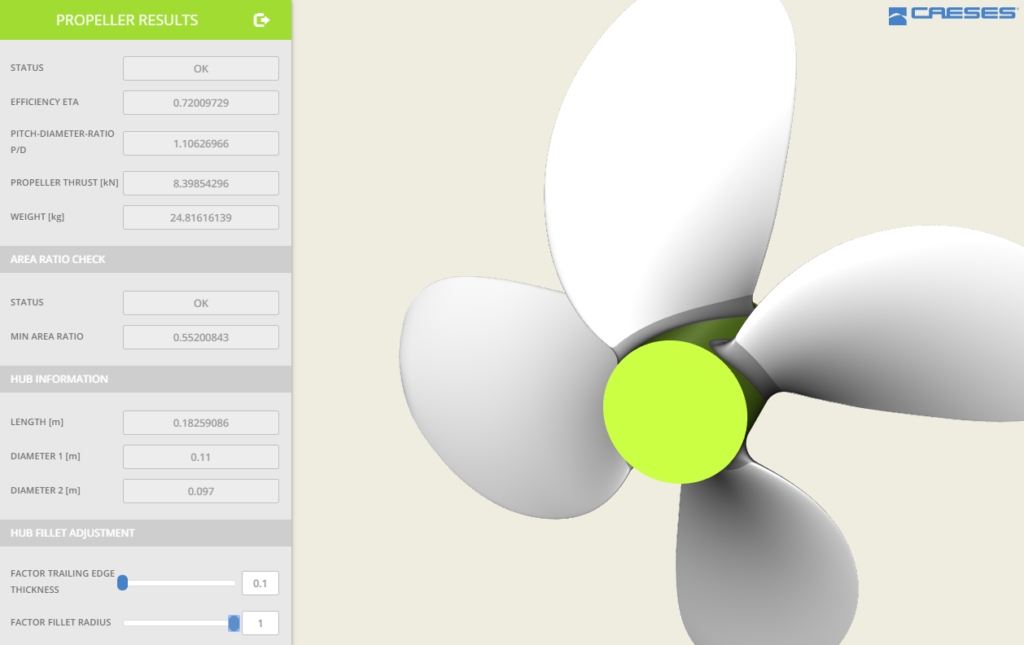
The geometry tool takes into account ISO standards for the various propeller thickness settings. The propeller open water efficiency is calculated as well as the pitch-diameter () ratio, the propeller thrust and the total weight. The final geometry can be downloaded as STL or STEP file.
Geometry Tool
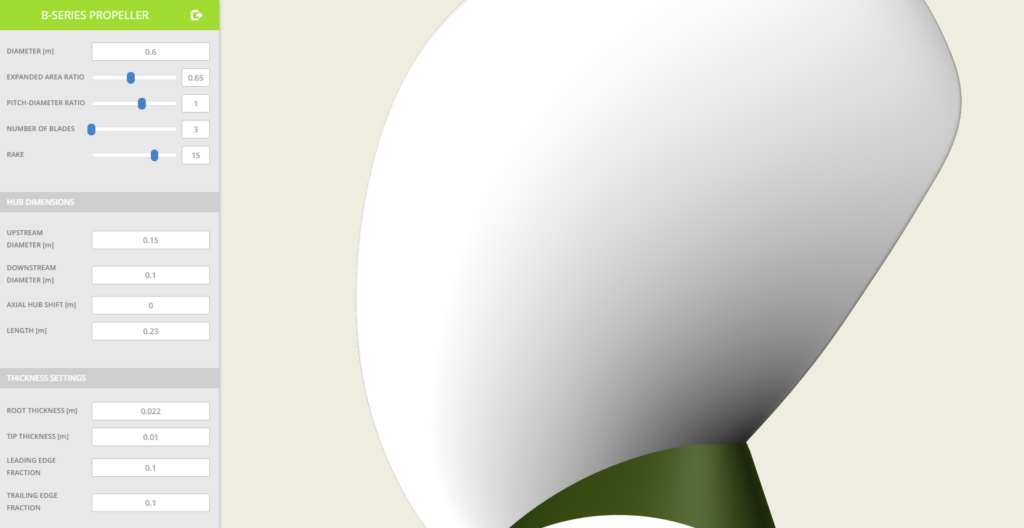
There is also a second app available on this website for advanced users, which allows more direct shape control. The online web app requires a set of pure geometrical quantities to generate the propeller, such as:
- Diameter
- Area ratio
- Number of blades
- Diameter
- Pitch
- Rake
- Thicknesses at the blade’s root and tip
- Hub diameters and length
- Blade axial positioning on the hub
- Leading & trailing edge shapes
There is no engine information required and no automated thickness calculations are triggered – it’s just a simple and fast geometry creator.