Surrounding Environment
Water Properties
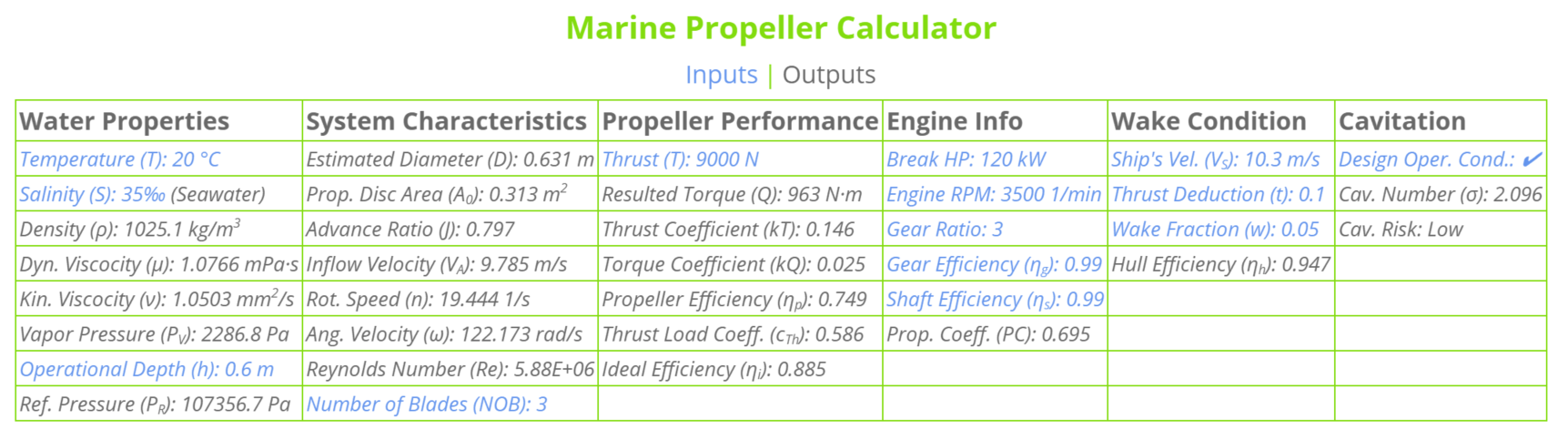
The propellerPropertyCalculator, a feature within CAESES, is designed to compute water properties using semi-empirical equations and various system characteristics [11]. It also evaluates propeller performance based on engine information and provides estimates for diameter and cavitation risk. All calculations for the outputs of the feature are detailed in this guide. These functionalities are summarized in the figure below.
Density
Seawater density (), typically around 1025 kg/m³, is influenced by temperature, salinity and pressure. The density is crucial as it directly affects the thrust generated by the propeller. Freshwater, with a density of around 1000 kg/m³, has lower density compared to seawater, impacting propeller efficiency differently.
Salinity
Measured in parts per thousand (ppt), typically ranges from 34 to 36 ppt in most ocean waters, with an average of 34.7 ppt. It is lower near the poles due to melting ice and higher in regions with high evaporation rates, such as the Mediterranean Sea. Higher salinity increases water density and vice versa, affecting buoyancy and corrosion rates in marine environments.
Temperature
Water temperature varies widely, from -2°C in polar regions to over 28°C in tropical areas and affects both density and viscosity. Warmer water decreases density and viscosity, whereas colder water increases both. These variations impact propeller efficiency and the mechanical stresses on propulsion systems. Ice forms below 0°C (depending on salinity) and poses major challenges for vessel movement and propeller performance, making it one of the most demanding environments in marine propulsion.
Dynamic Viscosity
The dynamic viscosity () reflects internal fluid friction when subjected to shear stress. In seawater and freshwater, dynamic viscosity decreases with higher temperature and lower salinity, impacting drag on propeller blades.
Kinematic Viscosity
Given by , the kinematic viscosity helps assess fluid flow under gravity's influence. It decreases with rising temperature and decreasing salinity.
Reference Pressure
The reference pressure () is the baseline pressure used for comparison in propeller design and analysis. It is typically set at atmospheric pressure, approximately 1 atm (101.325 kPa), at sea level. The reference pressure is used to normalize measurements and compare performance across different operating conditions.
Hydrostatic Pressure
The pressure exerted by a fluid at a given depth ( ) due to the weight of the overlying fluid is called the hydrostatic pressure (). It increases with depth and is calculated using ( ). Hydrostatic pressure affects propeller performance by influencing the density of the surrounding water.
Vapor Pressure
The pressure at which water vapor is in equilibrium with its liquid phase at a given temperature is called the vapor pressure (). It plays a role in cavitation, where vapor bubbles form and collapse on propeller blades, causing damage and noise and reducing efficiency. Lower water temperatures and higher salinity decrease vapor pressure, reducing cavitation risk, whereas higher temperatures and lower salinity increase vapor pressure, raising cavitation risks.
Laminar Flow
A type of fluid flow characterized by smooth, orderly movement where the fluid travels in parallel layers with minimal mixing between them. In marine propellers, laminar flow is typically found at the leading edge of the blade and near the root, particularly at lower speeds and for model-scale propellers.
Turbulent Flow
A type of fluid flow characterized by chaotic, irregular movement with eddies and swirls. In turbulent flow, the fluid experiences significant mixing and lateral movement between layers. In marine propellers, turbulent flow usually at the trailing edge of the blade and especially near the tip, particularly as the propeller speed increases and for full-scale propellers.
Ship's Wake
Refers to the disturbed water pattern left behind as the ship moves through the water at speed ( ). It includes waves and turbulence generated by the ship's hull and appendages, presenting a realistic scenario of its movement. This phenomenon is characterized by the wake fraction coefficient ( ), which can be defined in various ways, including Taylor's wake:
where is the speed encountered by the propeller.
Cavitation
Propeller cavitation is one of the most critical phenomena in marine propeller design. It occurs when the pressure, particularly on the suction side of a propeller blade, drops below the vapor pressure of the surrounding water. This causes the formation of bubbles or cavities as the water vaporizes. The subsequent collapse of these bubbles generates shock waves, which can lead to noise, vibration and potential physical damage to the propeller.
Burrill Diagram
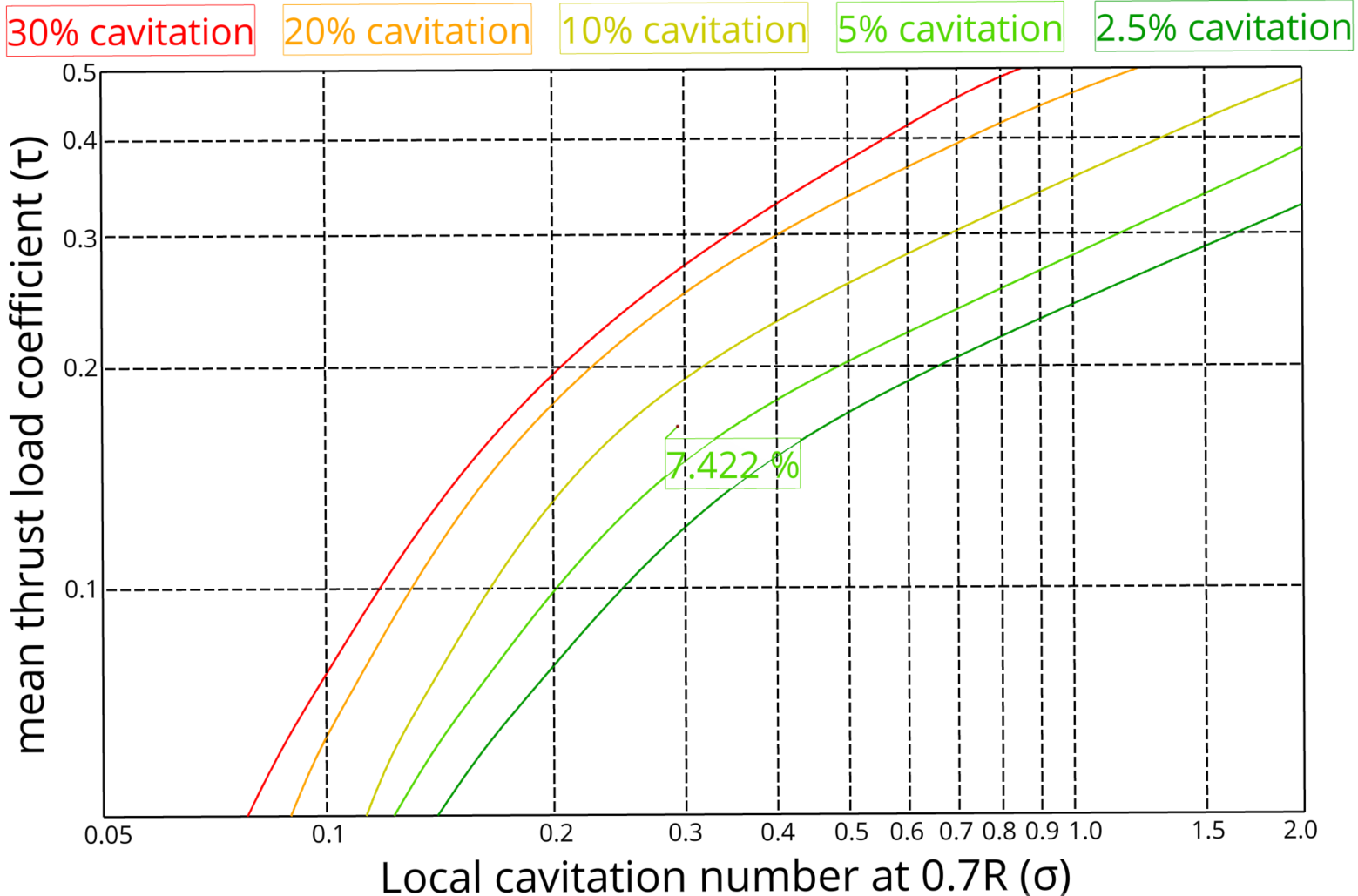
The Burrill Diagram is a widely acknowledged criterion used in the preliminary design of fixed-pitch conventional propellers [5]. It helps designers select suitable propellers by predicting the percentage of cavitation on the back side of the propeller blade. This prediction is based on two main parameters:
- the mean thrust load coefficient on the blades () on the y-axis and
- the cavitation number at a 0.7 radius () on the x-axis.
The equations for calculating these parameters are given below, where is the projected area of the propeller.
CFD Predictions of Cavitation
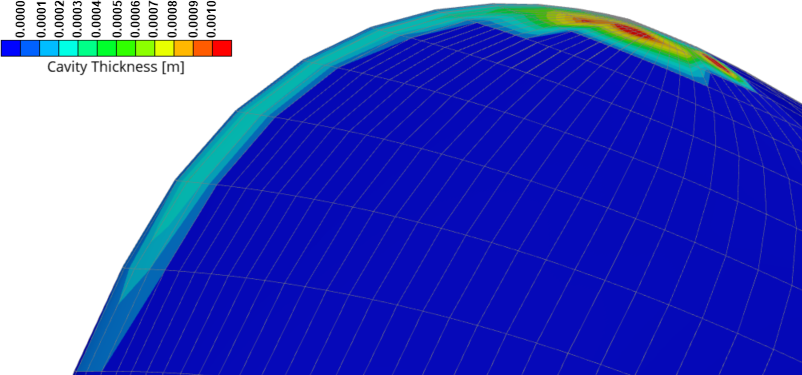
The cavity thickness refers to the size of vapor-filled regions that form around propeller blades during cavitation. Accurate calculation of cavity thickness is crucial for assessing the risk of cavitation and its effects on propeller performance, such as potential damage and efficiency loss. This can be determined not only through model tests in a basin or real-time data but also using CFD [6], as shown in the figure below. However, this approach requires careful consideration since CFD calculations are sensitive and varying parameters can lead to different results. Additionally, simulating cavitation phenomena in CFD can be very time-consuming.
Ventilation
Ventilation in marine propellers is a condition where air or exhaust gases are drawn into the water flow around the propeller blades. This phenomenon typically occurs near the water surface or in aerated conditions. When ventilation occurs, the propeller may lose efficiency and experience reduced thrust due to the less dense mixture of air and water it encounters. Additionally, ventilation can lead to increased stress on the propeller blades, potentially causing damage and further reducing performance.
Noise
Propeller noise refers to the sound generated by marine propellers as they operate underwater. This noise can vary in intensity and frequency depending on factors such as the speed of the propeller, the design of the blades and the hydrodynamic conditions. Propeller noise is a significant concern in marine environments due to its potential impact on marine life, navigation safety and onboard comfort. It often includes broadband noise from turbulent flow interactions and discrete tonal components related to blade passing frequencies.
Blade Passing Frequencies (BPF)
Blade passing frequencies are the distinct sounds produced at intervals corresponding to the rotation of the propeller blades. Specifically, these frequencies are related to the number of blades (Z) and the rotational speed of the propeller (n), causing periodic pressure variations as each blade passes a fixed point, contributing to the tonal noise observed. The BPF is given in RPM, which can be converted to Hertz (Hz) by dividing by 60.
Propeller Singing
Happens when low pressure near propeller blades leads to the formation and collapse of vapor bubbles, resulting in intense acoustic vibrations characterized by a distinctive whining sound. To address this, propeller designers often incorporate an "anti-singing edge" - a chamfered trailing edge typically found on the suction side of the blade. This feature is designed to prevent swirling flow eddies by effectively separating the flow from the blade surface. By strategically spacing points of flow separation in terms of thickness and position along the flow stream, the anti-singing edge helps mitigate cavitation effects and reduces noise levels.